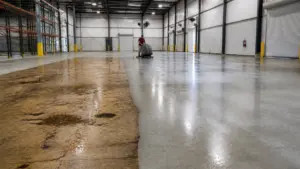
Warehouse floor cleaning is one of the most important parts of maintaining a safe and professional facility. If your warehouse floor still dries with a white haze, streaking, or a dusty film after mopping, the problem usually is not effort. The problem is soil redistribution. On concrete warehouse floors, traditional mopping often turns fine dust, grease, rubber transfer, and embedded soil into a slurry that gets spread across the surface instead of fully removed.
That is why so many facilities in Edison, Union, North Plainfield, and surrounding New Jersey service areas keep dealing with the same complaints: dull appearance, recurring residue, tacky walking surfaces, and tire marks that come right back. In the field, we see this most often on porous concrete where moisture carries contamination deeper into the surface instead of extracting it.
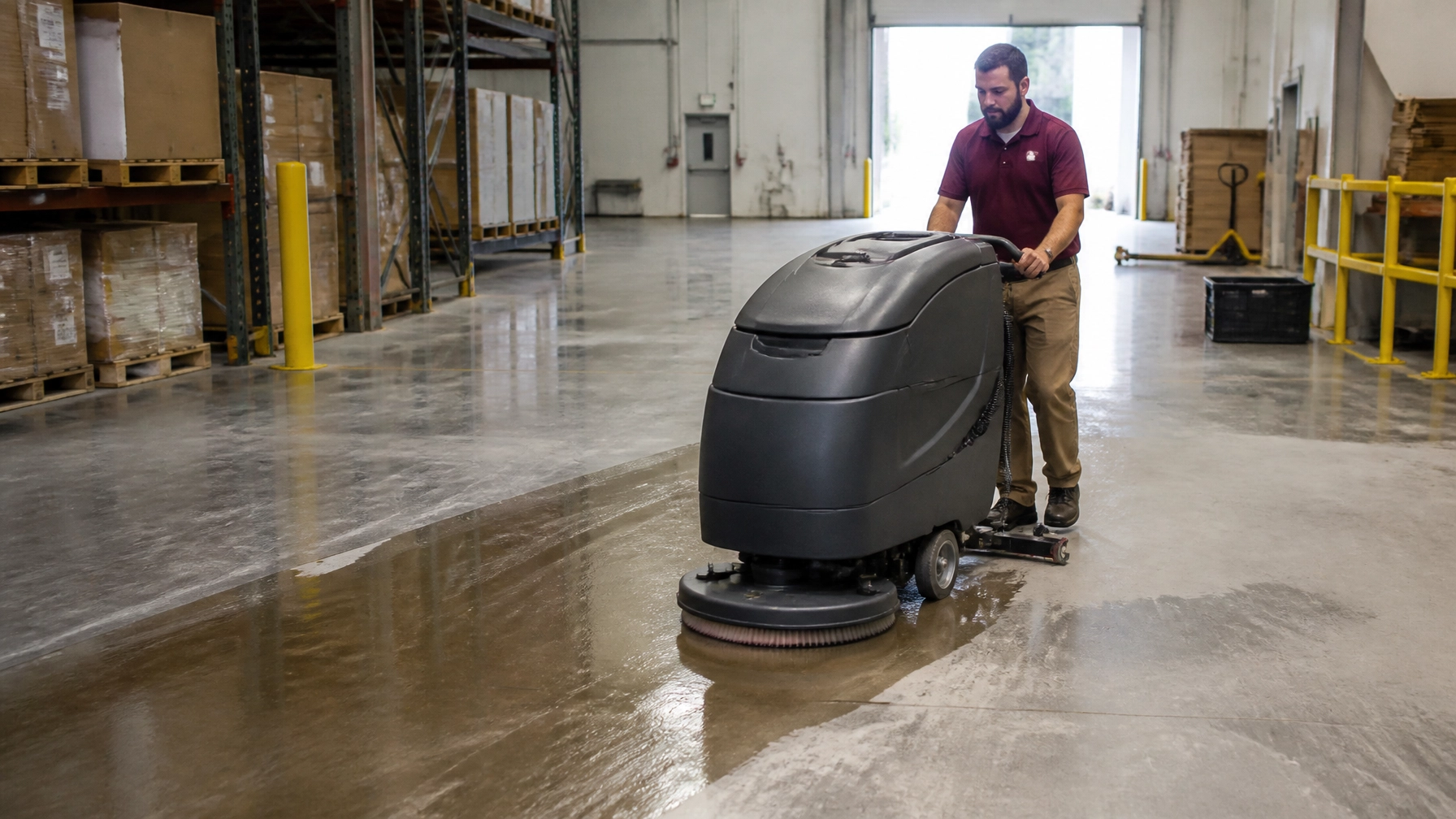
Professional results require more than a mop bucket. They require the right process, the right chemistry, and the right equipment. At Dust Busters, that typically means combining industrial auto scrubbers, proper pad selection, controlled chemical application, and vacuum recovery to lift soil off the floor and remove it from the building. In facilities with mixed cleaning needs, this work is often part of a larger commercial cleaning program, a deeper concrete floor cleaning service, or follow-up support after post construction cleaning.
Here is why that mop-and-bucket approach keeps failing and what works better in real warehouse environments.


The “Slurry” Effect: You’re Just Moving Dirt Around
Think about the mechanics of a mop. You dip it in a bucket of “clean” water (which stays clean for about thirty seconds), you drag it across the floor, and then you dip it back in. Within minutes, you aren’t cleaning with water anymore; you’re cleaning with a thin soup of grey sludge. In a warehouse environment, the soil load is heavy. We’re talking about industrial dust, outdoor salt from NJ winters, fine grit, and carbon from forklift tires. A mop doesn’t have the capacity to “pick up” that volume of debris. Instead, it creates a “slurry”: a wet mixture of dirt and water that you effectively paint across the concrete. When the water evaporates, the dirt stays. This is why you see that “white haze” or dusty residue even after a “cleaning.” You haven’t extracted the dirt; you’ve just redistributed it more evenly.Concrete is a Sponge (And Mopping Feeds It)
One of the biggest misconceptions about warehouse floors is that concrete is a solid, impenetrable surface. It’s not. Concrete is incredibly porous. If you looked at your warehouse floor under a microscope, it would look more like a hard, grey sponge than a piece of glass. When you mop, you are using a lot of water to move dirt. That water: and the fine particulates it carries: doesn’t just sit on top. It gets pushed down into the pores of the concrete. Over time, these contaminants “lock in.” This is why warehouse floors in older facilities in places like Springfield and Green Brook often look permanently grey or dingy, no matter how much you scrub them by hand. Professional concrete floor cleaning requires a process that pulls dirt out of those pores rather than pushing it in.
The Oil and Grease Nightmare
Whether you’re managing a distribution center in Union or a manufacturing plant in Warren, oil and grease are inevitable. Forklifts leak, pallets carry residues, and machinery drips. Mopping is perhaps the worst way to handle oil on concrete. Because oil and water don’t mix, a mop essentially acts as an applicator, spreading a thin, slick film of grease over a larger area. This creates a massive safety hazard. “Slip and fall” is a scary thought for any facility manager, and traditional mopping often makes the floor more slippery by leaving behind a soapy, oily residue.Warehouse Floor Forklift Traffic and Tire Marks
If your warehouse has high forklift traffic, you’ve seen those black streaks. These aren’t just “marks” on the surface; they are layers of heated rubber and carbon that have bonded to the concrete. A mop has zero mechanical agitation. It’s like trying to remove a permanent marker from a countertop with a wet paper towel: it just isn’t going to happen. To remove these marks, you need the down-pressure and high-speed rotation of industrial scrubbing pads. Our teams use specialized equipment that provides the agitation necessary to break those bonds without damaging the underlying concrete.Air Quality and the Dust Redistribution Problem
Dusting is the silent enemy of warehouse efficiency. It gets into inventory, settles on racking, affects equipment, and creates constant re-soiling on the floor. When you mop a dusty floor, you are not truly capturing that material. You are wetting it, spreading it, and leaving part of it behind as residue. Once that residue dries, foot traffic and forklift traffic push it back into the air and across the floor again. Professional industrial scrubbers are designed with vacuum recovery systems, which is a major difference. They apply solution in a controlled way, agitate the soil, and immediately recover the dirty water into a holding tank. That extraction step is what helps reduce recurring dust and haze. In warehouses that also need broader debris removal or cleanup after renovation work, we often pair floor work with post construction cleaning so the entire environment is addressed properly.
Industrial Scrubbers vs. The Traditional Mop: The Verdict on Warehouse floor cleaning method
So, why is professional scrubbing so much better? It comes down to three things: Agitation, Chemical Precision, and Extraction.- Agitation: Industrial scrubbers use heavy-duty brushes or pads that spin at high speeds, physically dislodging dirt from the concrete’s pores.
- Chemical Precision: We use professional-grade degreasers and surfactants that are specifically formulated for industrial soils, not just generic dish soap.
- Extraction: This is the most critical step. A powerful vacuum system immediately sucks up the dirty solution. The floor is left nearly dry, meaning there’s no tracking, no “slurry” drying back onto the surface, and significantly less downtime for your operations.
Office, Restroom, and Targeted Warehouse Cleaning
On this job, Dust Busters cleaned the office and restrooms, along with one area of the warehouse using truck-mounted cleaning equipment. The warehouse work was limited to that area. Facilities in Berkeley Heights, Scotch Plains, and nearby areas often benefit from periodic deep floor care instead of relying only on routine mopping. In some buildings, that plan also includes floor stripping and waxing for finished floors in offices or common areas and carpet cleaning for adjacent administrative spaces.Serving the Industrial Heart of New Jersey
Dust Busters LLC is proud to provide expert warehouse cleaning services throughout the state. We understand the specific challenges of New Jersey facilities: from the humidity that makes concrete “sweat” to the road salt that gets tracked in during the winter. We regularly provide services in:- Edison
- Union
- North Plainfield
- Green Brook
- Scotch Plains
- Warren
- Berkeley Heights
- Springfield