You’ve finally done it. You survived the renovation. The contractors have packed up their trucks, the new marble countertops in your Westfield kitchen look stunning, and you’ve spent the better part of your Saturday scrubbing every square inch of the place. You sit down with a well-deserved glass of wine, look around at your “clean” home, and smile.
Then, the sun hits the living room floor at just the right angle.
Wait. Is that… dust? Already? You just mopped that floor an hour ago. You look at the coffee table you wiped down this morning, and there it is again: a fine, ghostly layer of white powder that seems to have materialized out of thin air.
It feels like a prank. It feels like the house is gaslighting you. But it’s not a ghost, and you aren’t losing your mind. If you’re living in North Plainfield, Greenbrook, or anywhere in Central Jersey, you know that construction dust is a relentless roommate that refuses to take the hint.
So, why does construction dust keep coming back after you clean? Let’s pull back the curtain on the science of the “settle” and why your standard cleaning routine is likely losing the war.
The “Settle” Factor: Why Construction Dust Keeps Coming Back After Cleaning
The biggest mistake homeowners make is assuming that dust is only what you can see on the floor. In reality, construction dust: especially the fine particles from drywall sanding, masonry cutting, and sawdust: is incredibly light. We’re talking about particles as small as 2.5 microns. To give you some perspective, a human hair is about 70 microns wide.
Because these particles are so light, they don’t just fall to the ground the moment the saw stops. They stay suspended in the air for days, sometimes even weeks. It isn’t unheard of for dust particles to remain airborne for 48 to 72 hours after the last contractor leaves the site.
Every time you walk through the room, open a door, or even just sit on the couch, you create a tiny air current that keeps that dust swirling. You clean the floor, but the air is still “loaded.” Over the next few hours, gravity does its job, and that airborne dust slowly settles right back onto the surfaces you just polished. This is why professional Post Construction Cleaning isn’t just a one-and-done wipe down; it’s a systematic process of removing particles from the environment entirely.
The “Hidden” Factor: The Places You Aren’t Looking
If you want to stop the dust cycle, you have to think like a particle. Dust doesn’t just sit on the kitchen counter; it infiltrates every nook, cranny, and crevice in your home.
The HVAC Trap
Your heating and cooling system is the ultimate dust distributor. During a renovation in Edison, those fine particles get sucked into the return vents and trapped in the ductwork. Every time your AC kicks on, it’s basically a dust cannon, firing a fresh layer of drywall powder back into your living space. You should look for dust buildup on your vent covers as a primary warning sign. If the vents are dusty, the ducts are worse.
Hardware and Hinges
Have you checked the tops of your door hinges lately? Or the inside of your cabinet tracks? It isn’t unheard of for homeowners to spend hours on Tile and Grout Cleaning only to have the floor ruined by dust falling from the tops of door frames or ceiling fan blades.
Inside the Cabinets
Even if your cabinets were closed during construction, the dust found a way in. It creeps through the tiny gaps around the doors and settles on your clean dishes. When you open those doors to grab a plate, the movement of air pulls that hidden dust out and sends it back into the room.

The “Wrong Tool” Factor: Standard Vacuums vs. HEPA
This is where things get controversial. Your trusty household vacuum: the one you use for everyday crumbs: is likely your biggest enemy in a post-construction scenario.
Standard vacuum cleaners often lack the filtration necessary to trap ultra-fine construction dust. What happens? The vacuum sucks up the dust, but the particles are so small they pass right through the filter and are exhausted out the back of the machine. You aren’t cleaning; you’re just redistributing the dust into the air with a motor-powered fan. According to OSHA’s silica dust guidance, fine construction dust can remain airborne for extended periods and continue settling long after work is completed.
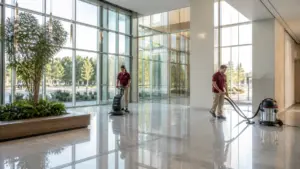
At Dust Busters, we use industrial-grade HEPA (High-Efficiency Particulate Air) vacuums. These filters are designed to trap 99.97% of particles as small as 0.3 microns. When we vacuum a site in Greenbrook, that dust stays in the machine. You should look for a cleaning partner who understands that a “regular” vacuum just won’t cut it for silica or drywall dust.
The “Air Quality” Factor: Why You Need Air Scrubbers
If the dust is in the air, you have to clean the air. This is a step almost every DIY cleaner misses.
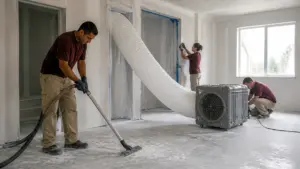
Professional post-construction crews use air scrubbers: portable filtration systems that pull air in, pass it through a series of filters (including HEPA), and exhaust clean air back out. By “scrubbing” the air while the cleaning is happening, we capture the particles that are disturbed during the process before they have a chance to resettle.
Without an air scrubber, you’re just waiting for gravity to finish the job for you, which can take weeks of frustrating “re-cleaning.”

Microfiber: The Magnet for Construction Dust
If you’re still using old rags or paper towels to wipe down your surfaces in North Plainfield, you’re essentially just pushing the dust around.
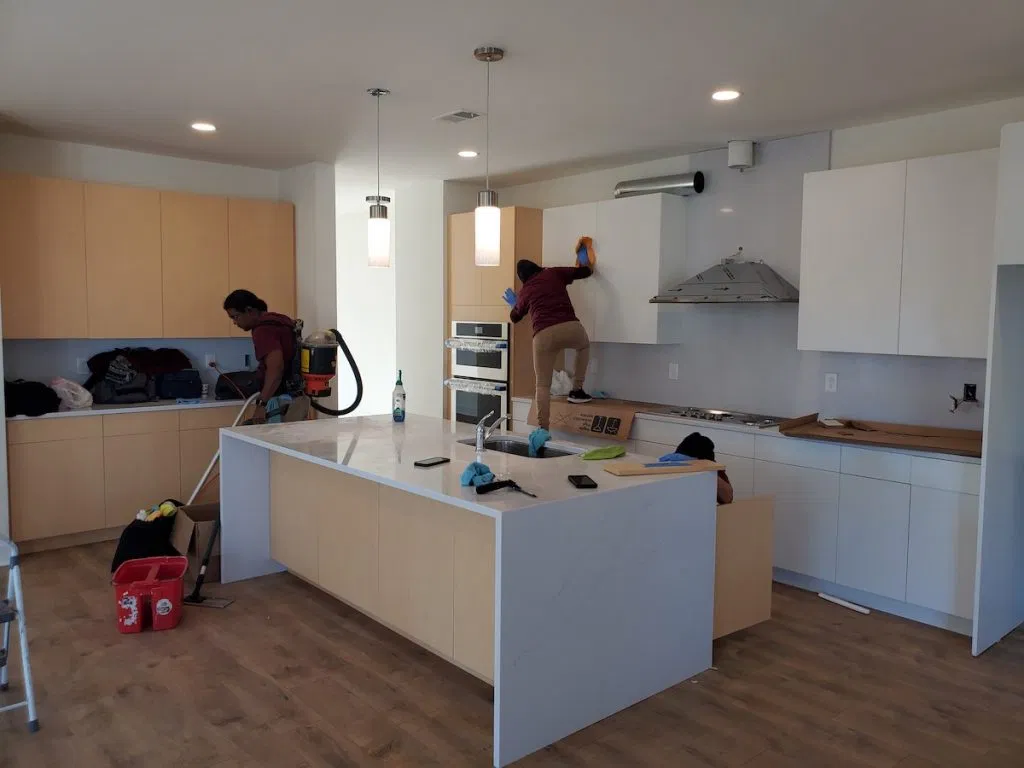
Microfiber is the gold standard for a reason. The fibers are split, creating a massive surface area that literally “grabs” and holds onto dust particles through a slight static charge. Instead of a dry cloth that flickers dust back into the air, we use damp microfiber technology to ensure that once we touch a surface, the dust is gone for good.
From HEPA vacuuming and detailed surface cleaning to air scrubbers and final touch-up cleaning, our team is equipped to handle projects of every size. We don’t just clean for appearance; we clean for health and long-term peace of mind.
The Professional Verdict: Why You Need a Shield
We understand the temptation to handle the cleanup yourself. You’ve already invested so much into your renovation. But the reality is that construction dust isn’t just an eyesore: it can be a health hazard. Silica dust, drywall compounds, and fine sawdust can irritate lungs and aggravate allergies.
It isn’t unheard of for a DIY cleanup to take four or five rounds of cleaning before the dust finally stops “returning.” That is hours of your life you won’t get back. It’s time spent away from your family, your work, and the enjoyment of your new space.
Whether you need Commercial Cleaning for a new retail space or a deep dive into your residential Window Cleaning to get those tracks dust-free, the methodology remains the same: Trap the dust. Filter the air. Protect the home.
Tired of cleaning the same dust over and over again? Dust Busters specializes in HEPA-filtered post-construction cleaning throughout North Plainfield, Green Brook, Warren, Watchung, Scotch Plains, and surrounding New Jersey communities. Contact us today for a professional evaluation and finally enjoy your renovation the way it was meant to be enjoyed — clean, healthy, and dust-free.