
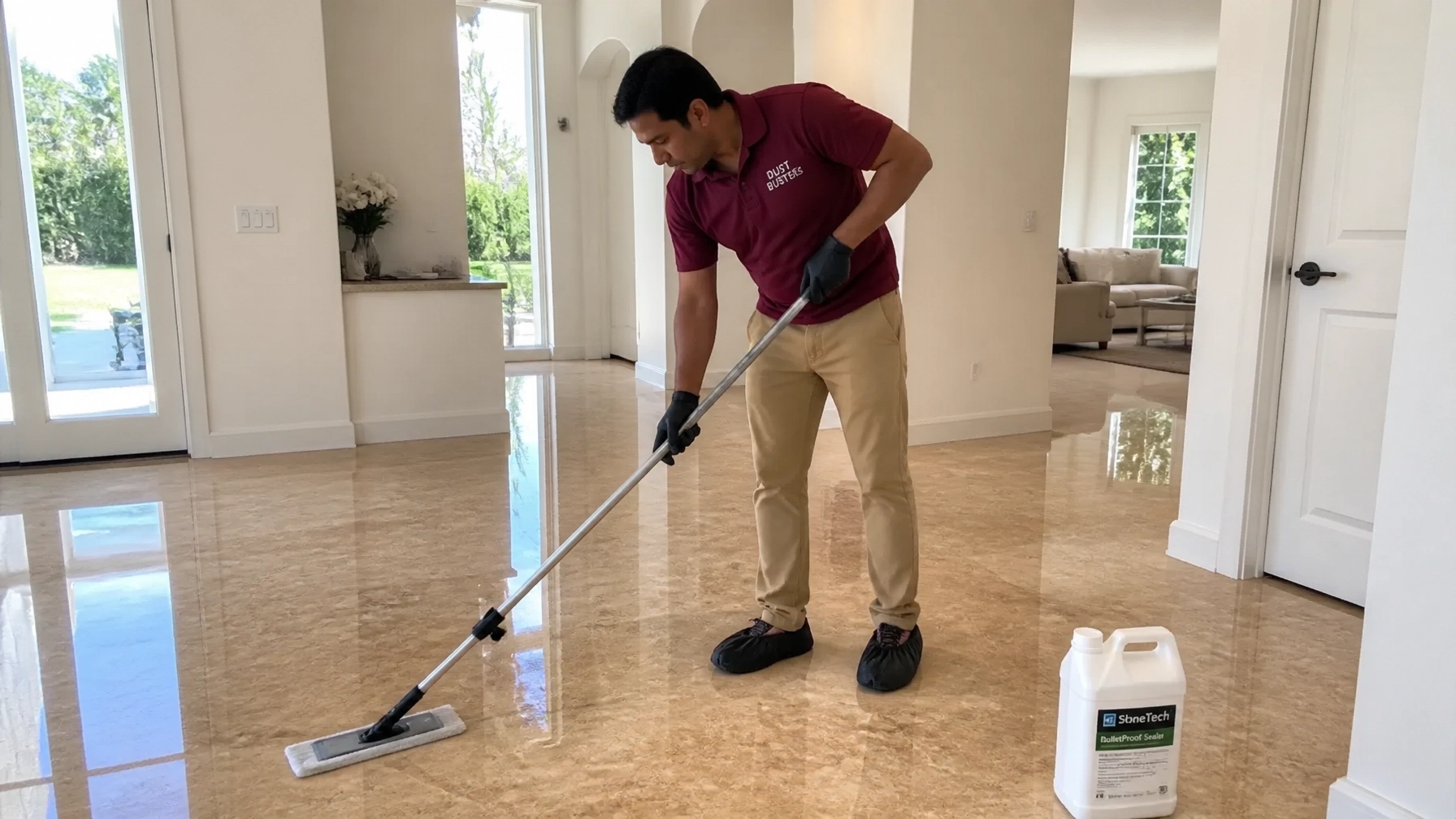
Caption: A Dust Busters technician applies a professional-grade impregnating sealer to a polished travertine floor in New Jersey, a key step in long-term tile and grout cleaning NJ maintenance and natural stone protection against stains, moisture, and daily foot traffic.
Natural stone floors: whether you’ve opted for the timeless elegance of marble, the rustic charm of travertine, or the industrial strength of slate: are a significant investment in your property. They bring a level of sophistication and durability that synthetic materials simply cannot replicate. However, that beauty comes with a responsibility. Unlike ceramic or porcelain, natural stone is porous. Without the right protection, your stunning entryway or high-end kitchen floor can quickly become a magnet for spills, dirt, and permanent staining.
One of the most frequent questions we receive at Dust Busters LLC is: "How often should I be sealing my stone floors?"
If you’re looking for tile and grout cleaning NJ experts, you already know that maintenance isn't just about mopping. It’s about preservation. In this guide, we’ll draw from our years of field experience in New Jersey’s diverse residential and commercial environments to help you build a maintenance schedule that keeps your stone in showroom condition.
Why Does Natural Stone Need Sealing for Tile and Grout Cleaning NJ Results?
To understand the "how often," you first need to understand the "why." Natural stone is made up of a complex network of tiny pores and capillaries. Think of it like a very hard, very dense sponge. When you spill coffee on an unsealed marble floor, the liquid doesn't just sit on top; it begins to migrate into the stone itself.
Sealing doesn't "laminate" the stone (unless you're using a topical coating, which we generally advise against for most floors). Instead, we use penetrating or impregnating sealers. These work by soaking into the pores and creating a hydrophobic barrier. This doesn't make the stone "stain-proof," but it gives you a crucial window of time to wipe up spills before they become permanent eyesores.
The Factors That Determine Your Sealing Schedule
There is no one-size-fits-all answer to how often you should seal your floors. Several variables at play in your New Jersey home or business will dictate the frequency.
1. The Type of Stone
Not all stones are created equal.
- Highly Porous (Marble, Travertine, Limestone): These stones are the most "thirsty." They absorb liquids rapidly and are sensitive to acidic substances.
- Dense (Granite, Slate, Quartzite): While still porous, these are much tighter. High-quality granite might only need sealing every few years, whereas marble often needs attention every 6 to 12 months.
2. Traffic and Usage
A guest bathroom floor that sees one person a day is a very different environment than a commercial lobby in North Plainfield or a busy family kitchen. Foot traffic wears down the sealer over time. Friction from shoes, combined with tracked-in grit and salt (especially during New Jersey winters), acts like sandpaper, slowly eroding the protective barrier.
3. Cleaning Products Used
This is where many property owners go wrong. If you are using harsh, acidic, or high-pH cleaners (like vinegar or bleach), you are likely stripping your sealer away every time you mop. We always recommend a pH-neutral cleaner specifically formulated for stone.

Caption: Before-and-after view of a commercial restroom floor in New Jersey after professional tile and grout cleaning NJ service, showing how deep cleaning can lift embedded soil, improve grout appearance, and help a business maintain a cleaner, more professional-looking space.
The Recommended Maintenance Schedule for Commercial Floor Cleaning NJ and Stone Floors
Based on our professional experience across New Jersey, here is a general timeline for natural stone maintenance. Keep in mind that these are guidelines; your specific environment may require more frequent care.
| Stone Type | Recommended Sealing Frequency | Maintenance Task |
|---|---|---|
| Marble & Travertine | Every 6–12 Months | Daily dust mopping; weekly pH-neutral damp mopping. |
| Granite | Every 1–3 Years | Wipe spills immediately; check seal annually with a water test. |
| Slate | Every 12–24 Months | Pay attention to "cleft" areas where dirt collects. |
| Commercial Floors | Every 3–6 Months | High-traffic commercial cleaning environments require aggressive protection. |
How to Tell if It’s Time to Reseal: The Water Test
You don't have to guess. There is a simple, effective way to check the integrity of your stone's protection. We call it the "Water Test."
- Find a high-traffic area of your floor (like in front of the sink or the entryway).
- Pour a small amount of water (about the size of a half-dollar) onto the stone.
- Wait 15 to 20 minutes.
- Observe the stone.
- Is the water still beading on top? Your sealer is still doing its job.
- Has the water soaked in or darkened the stone? The barrier has failed, and it is time to call for professional tile and grout cleaning NJ and sealing services.

Caption: This simple water test helps property owners in New Jersey confirm whether a natural stone floor still has effective protection. If the water darkens the stone instead of beading up, it is usually time for professional tile and grout cleaning NJ service and resealing.
The Dust Busters Professional Process for Tile and Grout Cleaning NJ
When we handle a stone restoration project, we don't just "wipe on some sealer." Our process is designed to ensure the stone is actually protected, not just covered.
Step 1: Deep Cleaning and HEPA Vacuuming
We start by removing all surface debris using HEPA-filtered vacuums to ensure no grit is trapped under the sealer. We then use specialized floor scrubbers and pH-neutral solutions to lift out embedded oils and dirt. If you’ve just finished a renovation, this is a critical part of our post-construction cleaning protocol.
Step 2: Drying
Applying sealer to a damp stone is a recipe for failure. We use air movers and specialized moisture meters to ensure the stone is completely dry all the way through before proceeding.
Step 3: Application of Premium Impregnators
We use professional-grade solvent or water-based impregnators. These are applied evenly using microfiber applicators and allowed to dwell. We then buff away the excess to ensure a streak-free, beautiful finish that protects the stone from within.

Caption: A Dust Busters technician performs commercial floor cleaning NJ service using professional rotary equipment to deep clean stone and hard surfaces, improve appearance, and prepare floors for proper sealing and ongoing maintenance.
Specialty Stone Care for North Plainfield Businesses
If you manage a retail store, office, medical space, restaurant, or mixed-use property in North Plainfield, natural stone maintenance gets a little more complicated. It is not just about whether the floor looks shiny on Monday morning. It is about how that surface holds up to steady traffic, moisture at entry points, spills, chair movement, cleaning chemical exposure, and the fine grit that gets tracked in from parking lots and sidewalks. Stone is tough, sure, but it is not invincible. That is where a smart maintenance plan earns its keep.
Many business owners assume that stone floors only need attention once they start looking rough. That sounds practical. It is also how small issues turn into expensive ones. Marble can lose its polish in traffic lanes. Travertine can collect soil in pits and textured areas. Slate can trap grime in its natural clefts. Grout lines can darken long before the stone itself looks dirty. In busy commercial settings, those changes can sneak up on you fast.
For North Plainfield businesses, specialty stone care usually means combining several services instead of relying on a one-size-fits-all mop-and-bucket routine. We often recommend:
- Regular HEPA vacuuming to remove abrasive dry soil before it gets ground into the finish
- pH-neutral stone cleaning to protect the sealer and avoid etching
- Targeted tile and grout cleaning NJ service in restrooms, break rooms, entrances, and other spill-prone areas
- Periodic commercial floor cleaning NJ maintenance using professional floor machines suited to the stone type
- Scheduled resealing based on actual wear patterns, not guesswork
This matters even more in shared commercial buildings, storefronts, and professional offices where appearance and safety go hand in hand. A stained or slippery floor does not exactly whisper “we’ve got everything under control.” It says the opposite. Clean, protected stone helps support a more polished environment for customers, staff, and tenants.
In our field experience across New Jersey, especially in places like North Plainfield, Summit, Westfield, and Scotch Plains, specialty stone care works best when it is proactive. You clean before the grit scratches. You seal before the spill stains. You correct the maintenance routine before harsh chemicals strip the protection away. That approach saves time, preserves the finish, and usually costs less than trying to undo years of wear in one dramatic visit.
If your property includes lobbies, restroom floors, hallways, entry vestibules, or stone-tiled common areas, it may also make sense to pair stone maintenance with related services like tile and grout cleaning, commercial cleaning, or even window cleaning to keep the entire space looking consistent. For facilities dealing with renovation dust or turnover work, our post-construction cleaning service can also help prevent stone and grout from getting buried under fine debris before the building is even fully back in use.
Common Mistakes to Avoid
- Waiting for the stone to look "dirty": By the time your stone looks dull or stained, damage may have already occurred. Sealing is preventative maintenance.
- Using "all-purpose" cleaners: Most grocery store cleaners are too harsh for natural stone. They will dull the finish and eat away at your sealer.
- Over-sealing: If you apply too much sealer too often without proper cleaning, you can end up with a sticky, cloudy residue that is difficult to remove.
The "Peace of Mind" Factor
For many of our clients in New Jersey, professional stone care is about more than just aesthetics: it’s about protecting a major asset. Whether you are managing a medical office that needs to maintain strict hygiene standards or you are a homeowner wanting to keep your sanctuary in residential "tip-top" condition, regular sealing is the key.
And here’s the part people usually underestimate: sealed stone is easier to keep clean, but it still needs the right maintenance routine. If the floor is in a lobby, restroom, break area, or corridor, ongoing commercial floor cleaning NJ service can make the difference between a polished, professional look and a floor that slowly starts waving a little white flag. Dirt wins when maintenance gets lazy. Stone wins when the plan is consistent.
It isn’t unheard of for an unsealed marble floor to be ruined by a single spilled glass of red wine or a leaked bottle of juice. Don't wait for a "scary" staining incident to take action. Protecting your stone today saves you the significant expense of professional honing or replacement tomorrow.
For businesses in North Plainfield, Berkeley Heights, Cranford, New Providence, and nearby New Jersey service areas, this is not just about appearance. It is about reducing wear, protecting your investment, and keeping public-facing spaces looking cared for every single day. That is why we often recommend pairing stone sealing with scheduled commercial cleaning or targeted tile and grout cleaning based on the building’s traffic patterns and floor type.

Caption: Dust Busters takes a detailed approach to residential and mixed-surface cleaning in New Jersey, helping homeowners maintain cleaner stone floors, fresher grout lines, and a healthier indoor environment from the entryway to the kitchen.
Ready to Protect Your Investment?
If you aren't sure when your floors were last serviced, or if they’ve failed the water test, it’s time to act. Maintaining natural stone requires a specialized touch and the right equipment: from high-powered floor scrubbers to industrial air movers.
At Dust Busters LLC, we provide the expertise and the professional-grade solutions needed to keep your New Jersey property looking its best. Whether it's a one-time deep clean and seal, routine tile and grout cleaning NJ service, or scheduled commercial floor cleaning NJ maintenance, we’ve got you covered.
Contact us today for a consultation on your stone floor needs.
- Visit our website: dustbusterservices.com
- Get a Quote: Contact Dust Busters
Let us help you maintain the "sanctuary" of your home or the "professionalism" of your business with stone floors that shine with health and cleanliness.