Have you ever walked through your facility in Edison or Union and noticed that your “clean” floors still feel slick under your boots? Or maybe those black forklift tire marks have become so thick they’re practically part of the floor design?
If you’re managing a warehouse in New Jersey, you know that the floor isn’t just something you walk on: it’s a critical piece of your operational infrastructure. A dirty floor isn’t just an eyesore; it’s a liability. Whether you are dealing with high-volume distribution in North Plainfield or heavy manufacturing, the state of your concrete floors directly impacts safety, equipment longevity, and even employee morale.
At Dust Busters, we’ve spent years in the trenches (and the aisles) across New Jersey, tackling everything from post-construction concrete dust to decade-old grease buildup. In this guide, we’re sharing the professional perspective on what it takes to maintain an industrial floor that is safe, compliant, and actually clean.
The Reality of Warehouse Floor Neglect
It isn’t unheard of for facility managers to push floor cleaning to the bottom of the priority list. After all, there are shipments to track and teams to manage. But ignoring the floor leads to a “snowball effect” of problems.
1. Oil and Grease: The Silent Slip Risk
In industrial settings, oil and grease are inevitable. Leaky pallet jacks, forklift hydraulics, and product spills create localized “ice rinks.” When these spills aren’t professionally addressed, they soak into the porous concrete, making them nearly impossible to remove with a standard mop. This creates a persistent slip-and-fall hazard that can lead to costly workers’ compensation claims or OSHA inquiries.
2. Forklift Tire Marks and Rubber Buildup
High-traffic zones in NJ warehouses often develop “ghost tracks”: thick, black rubber deposits from forklift tires. These aren’t just ugly; they actually reduce the traction of the floor. Over time, these marks can become sticky or slick, depending on the environment, making it harder for your equipment to stop safely.
3. Concrete Dust and Air Quality
One of the biggest challenges in New Jersey industrial spaces is “dusting.” As forklifts grind against unsealed concrete, they create fine particulates. If you’ve ever noticed a thin layer of gray powder on your racking or inventory, you’re looking at concrete dust. OSHA has strict standards around respirable silica exposure, which is why dust control should be taken seriously.

The Dust Busters Process: How We Restore Your Floors
We don’t just “wash” floors; we restore them. When we walk into a facility in Union or North Plainfield, we bring a systematic approach that handles the grime at a molecular level. Our concrete floor cleaning process is designed for durability and safety.
Step 1: Pre-Spraying and Degreasing
The secret to removing industrial grease isn’t just scrubbing; it’s chemistry. We start by applying professional-grade degreasers to the most heavily soiled areas. We allow these solutions to “dwell,” breaking down the chemical bonds of the oil and lifting it out of the concrete pores.
Step 2: Industrial Scrubbing
For large-scale warehouse environments, a mop and bucket are useless. We use heavy-duty industrial floor scrubbers equipped with specialized pads or brushes. These machines provide the mechanical agitation necessary to break up impacted rubber tire marks and deep-seated dirt.
Step 3: High-Powered Extraction
This is where many “cleaning” companies fail. If you don’t extract the dirty water immediately, it just settles back into the concrete as it dries. We utilize truck-mounted extraction systems that pull the slurry off your floor and into our waste tanks. This ensures that when we leave, your floor is dry and truly clean, not just “spread around.”

Safety Standards and Compliance
You should look for a cleaning partner that understands the stakes. You should look for a team that prioritizes safety over speed. And you should look for a company that understands NJ-specific industrial challenges.
When we perform commercial janitorial services or specialized warehouse cleaning, we keep safety at the forefront:
- Slip Resistance: We ensure that the cleaners we use do not leave a soapy film that could actually increase slipperiness.
- Airborne Particulates: During heavy dust removal, we often deploy HEPA air scrubbers. We reduce fine dust and airborne particles that can affect comfort, air quality, and cleanliness within the facility.
- OSHA Awareness: We follow protocols that help keep your facility aligned with safety standards, focusing on high-traffic areas and egress paths.

Why Industrial Warehouse Floor Cleaning NJ Matters
Operating in the New Jersey industrial corridor means dealing with unique environmental factors. Our warehouses in Edison, for example, often deal with road salt tracked in during the winter and high humidity in the summer: both of which can wreak havoc on concrete surfaces.
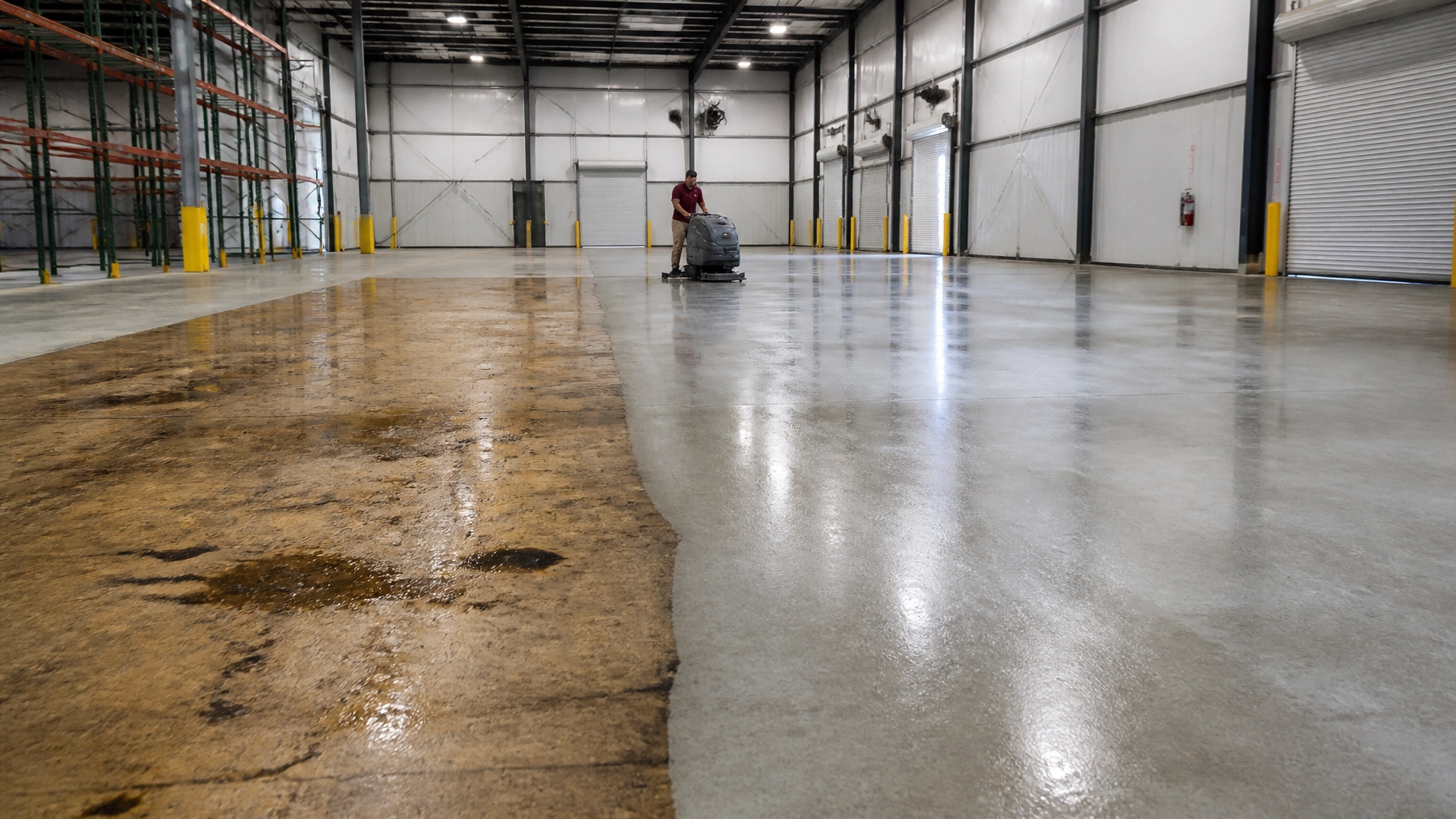
Recently our team restored a heavily soiled warehouse floor in Edison, NJ where years of forklift traffic, oil residue, and embedded dirt had accumulated on the concrete surface.
Whether you are preparing a facility for a new tenant and need post-construction cleaning or you’ve had a major spill that requires emergency cleaning services, having a local NJ team that can be on-site quickly is a massive advantage.
We also serve nearby industrial and commercial facilities in Green Brook, Scotch Plains, Warren, Berkeley Heights, and Springfield, along with Edison, North Plainfield, Union, and other parts of Northern and Central New Jersey.
Long-Term Maintenance: Beyond the Deep Clean
A deep clean is a great “reset button,” but the best facility managers know that ongoing care is what saves money in the long run. We often recommend a scheduled maintenance plan that might include:
- Daily Autoscrubbing: Using your internal team or our janitorial crews to keep surface dust at bay.
- Concrete Sealing: To prevent oil from soaking back into the pores.
- Periodic Stripping: If your warehouse has a finished floor, regular floor stripping and waxing can keep the surface protected and looking professional.
The Bottom Line
At the end of the day, your warehouse floor is a reflection of your operation. It affects how your employees feel about their workspace and how your clients perceive your professionalism. Your floor should look clean, safe, and professionally finished : not dusty again the next day.
If you’re tired of looking at those tire marks or worrying about the next slip-and-fall, it might be time to bring in the professionals. We’ve seen it all, and we’ve cleaned it all.
Ready to see what a professional industrial clean looks like for your NJ facility?
Contact Dust Busters today for a floor assessment in Edison, North Plainfield, Union, Green Brook, Scotch Plains, Warren, Berkeley Heights, Springfield, or anywhere in Northern/Central New Jersey. Let’s get your facility back to a standard you can be proud of. Call Dust Busters at 908-764-0070 for a warehouse floor assessment.