
If you’ve managed a facility in New Jersey for any length of time, you know exactly what’s coming. The first frost hits, the salt trucks start rolling through Newark and Elizabeth, and suddenly, your warehouse floors are no longer just "floors": they are a magnet for white, crusty sludge that never seems to go away.
It starts at the loading docks. A forklift tracks in a slurry of melted snow and road salt. Within hours, that slurry dries into a fine white powder that coats your inventory, clogs your equipment, and eats away at your concrete. If you’re like most NJ facility managers, you’ve probably felt that mid-winter frustration where no matter how much you sweep, the floor still looks gray and gritty.
Is your warehouse actually ready for the winter shift? Or are you just waiting for the damage to happen?
Preparing your warehouse floors for winter isn't just about appearances; it’s about protecting one of your most expensive assets. At Dust Busters, we’ve seen how one bad winter can cause years of wear on unsealed concrete. This guide is your roadmap to preventing salt damage, reducing slip-and-fall risks, and keeping your New Jersey facility looking professional when the weather is at its worst.
The Hidden Chemistry of the "White Film"
You might think that white haze on your floor is just "salt." In reality, it’s a chemical residue that is actively attacking your floor’s pH balance. Most ice-melt products used across the Tri-State area are highly alkaline. When this residue sits on your concrete floor, it doesn't just stay on the surface; it can actually etch the finish and weaken the top layer of the concrete through a process called spalling.
If your floors aren't properly prepared, that salt-laden water seeps into tiny cracks, freezes, expands, and turns small fissures into major repair bills by March.
Step 1: The Pre-Winter Floor Audit
Before the first snow flies, you need to walk your floor. We recommend doing this in early September. You aren't just looking for dirt: you’re looking for vulnerabilities.

Caption: Even small salt deposits can lead to significant concrete pitting and structural damage over time.
What you should look for:
- Open Joints and Cracks: Any opening in the concrete is an invitation for salt-water intrusion.
- Worn Coatings: Check the high-traffic aisles. If the concrete looks "thirsty" or dull compared to the corners, your protective seal is gone.
- Low Spots: Identify where meltwater from forklifts will pool. These are your future "salt-burn" zones.
If you find damage now, it’s much cheaper to repair it during a scheduled commercial cleaning session than to wait until the spring when the damage has doubled in size.
Step 2: Deep Scrubbing and Restoration
You cannot protect a dirty floor. The most critical part of winter prep is a professional deep scrub to remove the summer’s buildup of tire marks, oil, and dust.
Using a standard mop and bucket in a 50,000-square-foot warehouse is like trying to empty the Atlantic with a teaspoon. It just moves the dirt around. To truly prepare for the winter shift, you need mechanical agitation and high-volume extraction.

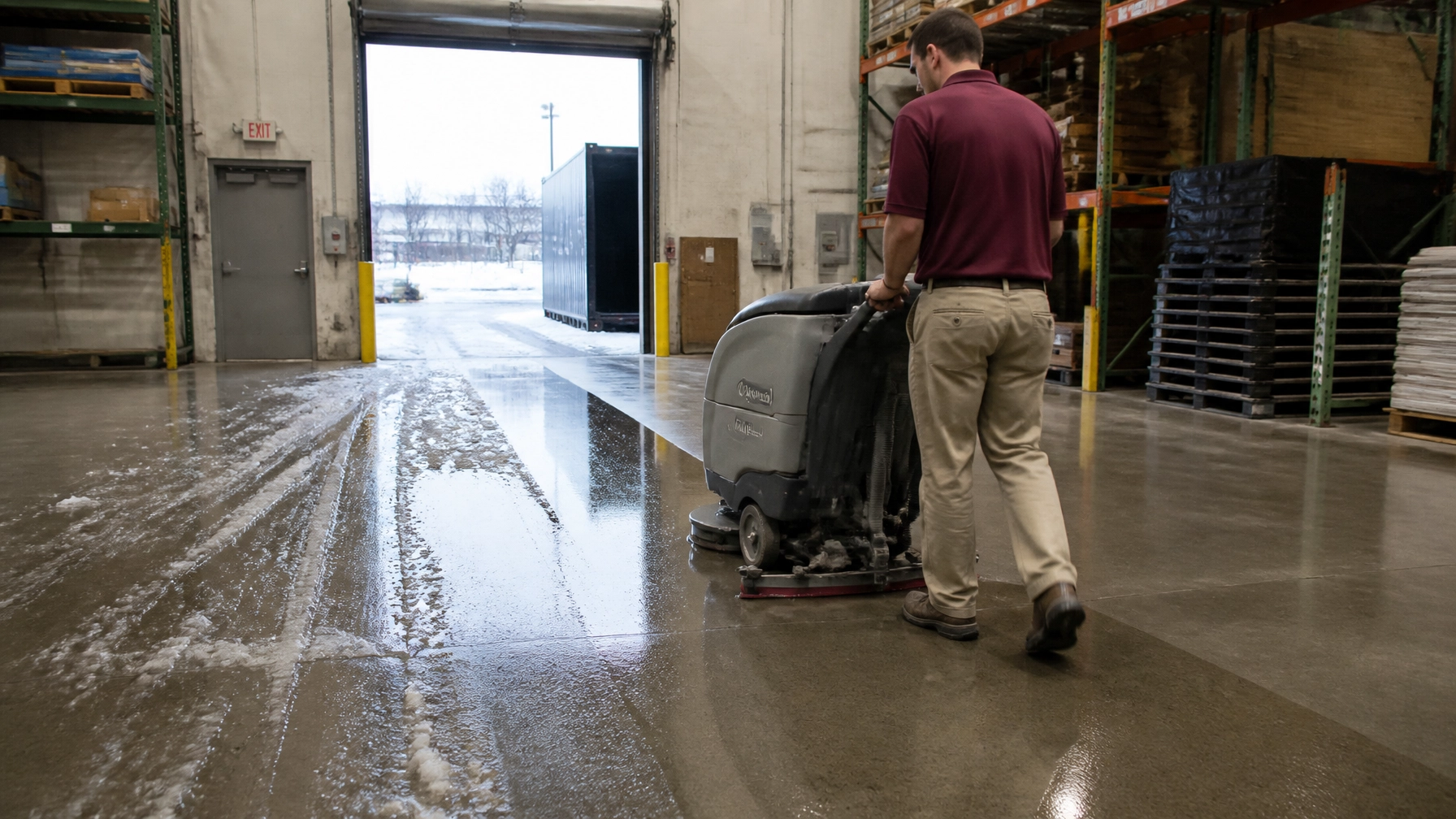
Caption: Our industrial-grade floor scrubbers use mechanical agitation to lift deep-seated grime that standard cleaning methods miss.
At Dust Busters, we use heavy-duty floor scrubbers that apply the right downward pressure to lift contaminants out of the concrete pores. This ensures that when we apply a sealer, it’s bonding to the concrete, not the dirt. If you’re looking for warehouse floor cleaning in NJ, this deep-clean stage is where the magic happens.
Step 3: Strengthening Your Defense with Sealers
Once the floor is stripped of grime, it needs a shield. For NJ warehouses, we often recommend a high-quality concrete densifier or a penetrating sealer.
Think of a sealer as a "permanent raincoat" for your floor. It fills the microscopic pores in the concrete so that salt and moisture can’t get in. Not only does this prevent structural damage, but it also makes your daily cleaning ten times easier. When salt can’t penetrate the surface, it simply sits on top, waiting to be swept away.
If your facility also has attached office spaces, don't forget that salt travels. We often see beautiful wooden floors in NJ offices ruined because warehouse salt was tracked through the door. A good sealer in the warehouse acts as the first line of defense for the entire building.
Step 4: The 3-Stage Matting Fortress
If you want to keep the winter outside, you have to stop it at the door. Most facility managers put down one small rug and call it a day. That rug is usually saturated and useless by 9:00 AM.

Caption: A properly installed 3-stage matting system can trap up to 80% of tracked-in salt and moisture before it reaches your main floor.
The 3-Stage Approach:
- The Scraper (Exterior): A heavy-duty mat outside the dock doors to knock off large chunks of snow and ice.
- The Buffer (Vestibule): An aggressive, carpet-style mat to scrub the fine salt and grit from boots and forklift tires.
- The Wiper (Interior): A long runner (at least 15-20 feet) to absorb the remaining moisture.
It isn’t unheard of for a single person to track in over a pound of salt and dirt during a heavy NJ winter. Multiply that by your entire staff and a fleet of forklifts, and you can see why the "fortress" approach is necessary.
Step 5: The Daily Winter Protocol (Neutralize, Don't Just Clean)
Once the snow starts, your cleaning chemistry has to change. Standard floor cleaners often struggle with the high pH of road salt, leaving behind that frustrating white haze.
You should look for a salt neutralizer. These are specialty cleaning agents designed to break the bond between the salt crystals and the floor. When we perform routine warehouse cleaning, we emphasize the use of pH-neutral cleaners that won't strip your fresh sealer but will effectively dissolve the "winter crust."

Caption: The difference between a salt-damaged floor and a professionally maintained one is clear: literally.
Why Professional NJ Facility Managers Choose Dust Busters
We know that as a facility manager, you have a thousand priorities. The last thing you want to worry about is whether your floor is going to be a slip-hazard tomorrow morning.
Choosing a professional partner means you get access to the heavy-duty equipment: HEPA vacuums, truck-mounted extraction, and industrial scrubbers: that your in-house team might not have. Plus, working with an insured cleaning company gives you the peace of mind that the job will be done safely and correctly the first time.
Don't Wait for the First Salt Truck
The "Winter Shift" in New Jersey happens fast. One day it’s 60 degrees, and the next, you’re dealing with a slushy mess at every dock door. By preparing your floors now: through deep cleaning, sealing, and proper matting: you’re not just making the floor look better; you’re extending its life and protecting your team.
Are you ready to get your warehouse "Business Ready" for the winter? From carpet cleaning in NJ offices to heavy-duty warehouse floor restoration, we have the tools and the expertise to handle it all.
Contact Dust Busters today for a free site audit. Let’s make sure your floors are a sanctuary of productivity, not a salt-damaged liability.